Physical processes at shelf break fronts control the interaction between shelf seas and the open ocean. Marked by strong hydrographic gradients and energetic circulation, shelf break regions are often associated with elevated primary productivity, carbon sequestration, and thermohaline exchange. Using a synthesis of remotely-sensed, in situ, and modelled data, this work investigates subseasonal (< 60 day) biophysical variability (eg. chlorophyll-a, stratification, freshwater influence) along a shelf break front situated in southeast Aotearoa/New Zealand. This is a culturally and ecologically significant region associated with increased chlorophyll-a (Chl-a) biomass, high trophic level species, and fisheries activity. Despite the importance of this region, previous work has been mostly limited to infrequent boat-based surveys, limiting the understanding of this region on time scales of less than a month.
Using 22 years of remotely-sensed Chl-a data, the processes driving episodic summer Chl-a bloom events over the shelf break are investigated. Analysis of local wind stress showed a lagged relationship between shelf break Chl-a and along-front wind stress, with Chl-a enhancements as large as the seasonal cycle occurring approximately 5 days after periods of upfront wind stress. Historic in situ water samples support the remotely sensed Chl-a observations, and also indicate nutrient-replete conditions at the shelf break throughout summer, suggesting that another limiting factor controls these episodic blooms. A mooring deployment over an austral summer season captures mixed layers deepening to the seabed following downfront wind stress, and rapidly restratifying following upfront winds. From this, potential physical mechanisms controlling light availability are discussed.
To better understand the structure and time scales of stratification variability over the shelf, a cross-shelf mooring array was deployed over an austral summer. Multiple instances of mixed layer deepening/shoaling were observed through the deployment, associated with downfront/upfront wind stress. These results challenge previous characterisations of the Otago shelf as seasonally stratified in summer, likely stemming from fair-weather bias in boat-based surveys that reduces the likelihood of observing deep mixed layers following strong downfront wind stress. A stratification budget is calculated to investigate the contributions of different physical mechanisms to observed stratification variability. This budget suggests that periods of destratification, associated with downfront winds, are likely driven by onshore Ekman transport, with rapid restratification over the mid to outer shelf being associated with upfront winds and formation of submesoscale instabilities in the mixed layer.
Output from a realistic numerical model is used to study the evolution of a nationally-significant river plume and the physical mechanisms controlling its evolution and offshore extent. The spatial pattern of the river plume is shown to be related to the rate of freshwater discharge, along-front wind stress, and shelf current. During periods of downfront wind stress the freshwater plume is constrained to the coast, during upfront wind stress the plume spreads over the shelf as a thin surface layer. Occasionally, upfront wind stress causes a reversal of currents over the shelf and the plume detaches from the coast and flows straight offshore, passing the shelf break and being entrained in the shelf break current. Using 22 years of remotely-sensed Chl-a data, the processes driving episodic summer Chl-a bloom events over the shelf break are investigated. Analysis of local wind stress showed a lagged relationship between shelf break Chl-a and along-front wind stress, with Chl-a enhancements as large as the seasonal cycle occurring approximately 5 days after periods of upfront wind stress. Historic \textit{in situ} water samples support the remotely sensed Chl-a observations, and also indicate nutrient-replete conditions at the shelf break throughout summer, suggesting that another limiting factor controls these episodic blooms. A mooring deployment over an austral summer season captures mixed layers deepening to the seabed following downfront wind stress, and rapidly restratifying following upfront winds. From this, potential physical mechanisms controlling light availability are discussed.
To better understand the structure and time scales of stratification variability over the shelf, a cross-shelf mooring array was deployed over an austral summer. Multiple instances of mixed layer deepening/shoaling were observed through the deployment, associated with downfront/upfront wind stress. These results challenge previous characterisations of the Otago shelf as seasonally stratified in summer, likely stemming from fair-weather bias in boat-based surveys that reduces the likelihood of observing deep mixed layers following strong downfront wind stress. A stratification budget is calculated to investigate the contributions of different physical mechanisms to observed stratification variability. This budget suggests that periods of destratification, associated with downfront winds, are likely driven by onshore Ekman transport, with rapid restratification over the mid to outer shelf being associated with upfront winds and formation of submesoscale instabilities in the mixed layer.
Output from a realistic numerical model is used to study the evolution of a nationally-significant river plume and the physical mechanisms controlling its evolution and offshore extent. The spatial pattern of the river plume is shown to be related to the rate of freshwater discharge, along-front wind stress, and shelf current. During periods of downfront wind stress the freshwater plume is constrained to the coast, during upfront wind stress the plume spreads over the shelf as a thin surface layer. Occasionally, upfront wind stress causes a reversal of currents over the shelf and the plume detaches from the coast and flows straight offshore, passing the shelf break and being entrained in the shelf break current.
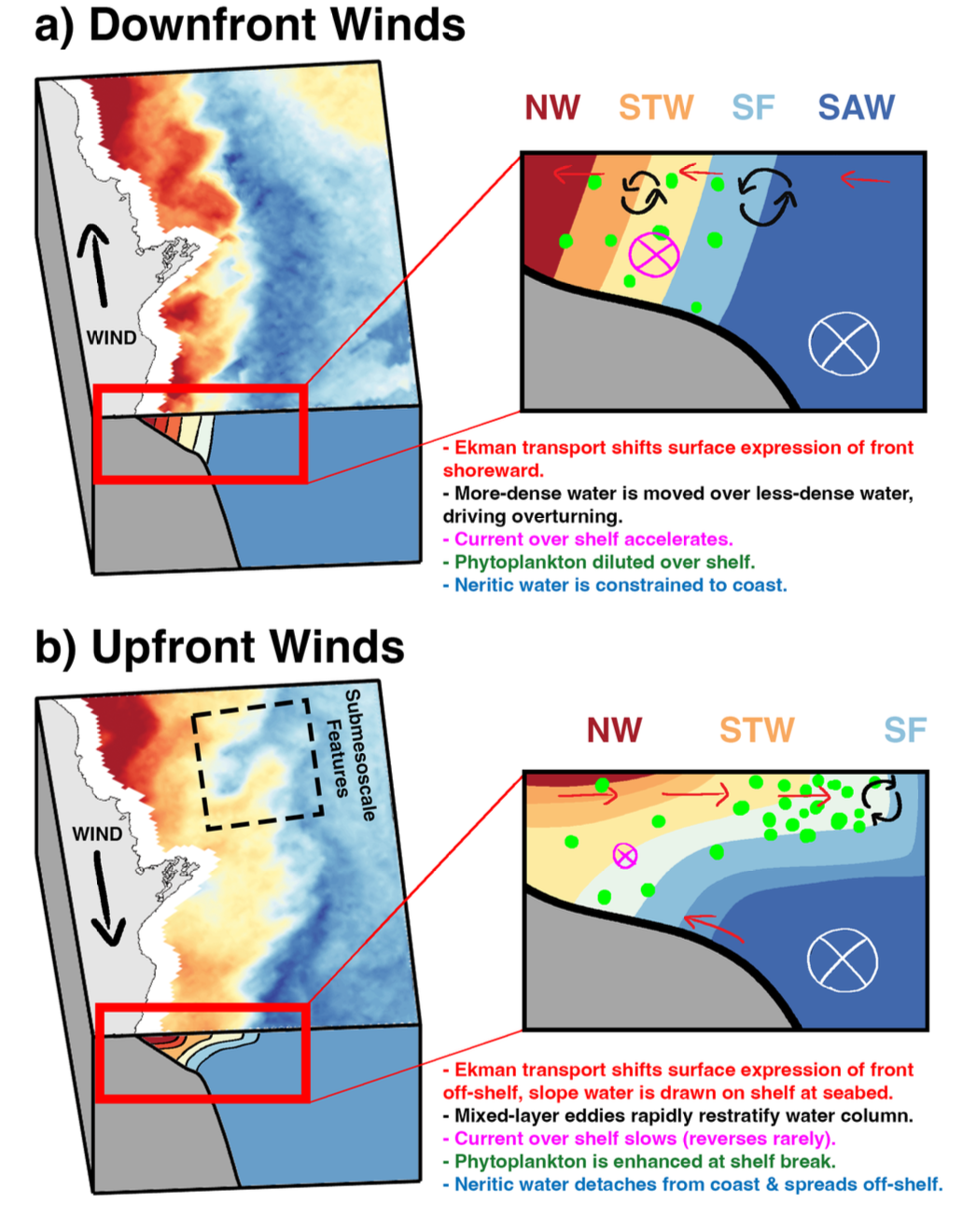
IMOS AVHRR sea surface temperature on January 10th, 1999 (a), and February 1st, 2010 (b), following a period of downfront winds (mean along-front stress 0.03 N/m2), and upfront winds (mean along-front stress -0.03 N/m2), respectively. Frames to the right show a hypothetical isothermal structure, with illustrations of potential subseasonal physical mechanisms - as proposed in this thesis.